Old Faithful Inn Dining Room & Bear Pit Lounge, Yellowstone National Park, Wyoming

Recently I posted about my two-week road trip from Chicago to Oakland in 2003, mostly on two-lane U.S. highways. Today we return to a stop on that road trip, the historic Old Faithful Inn in Yellowstone National Park. Staying in one of the historic lodges in a National Park is a special treat so I prefer spending a few nights in one over staying outside the park in a standard motel or hotel. Usually they are more expensive so it depends on my trip’s budget. But in general they are worth the additional cost. The Old Faithful Inn definitely was worth the money because of its historic charm and its location near Old Faithful Geyser. I couldn’t get a decent picture of the soaring lobby of log and branch balconies surrounding a massive stone fireplace so this vintage postcard will have to do.
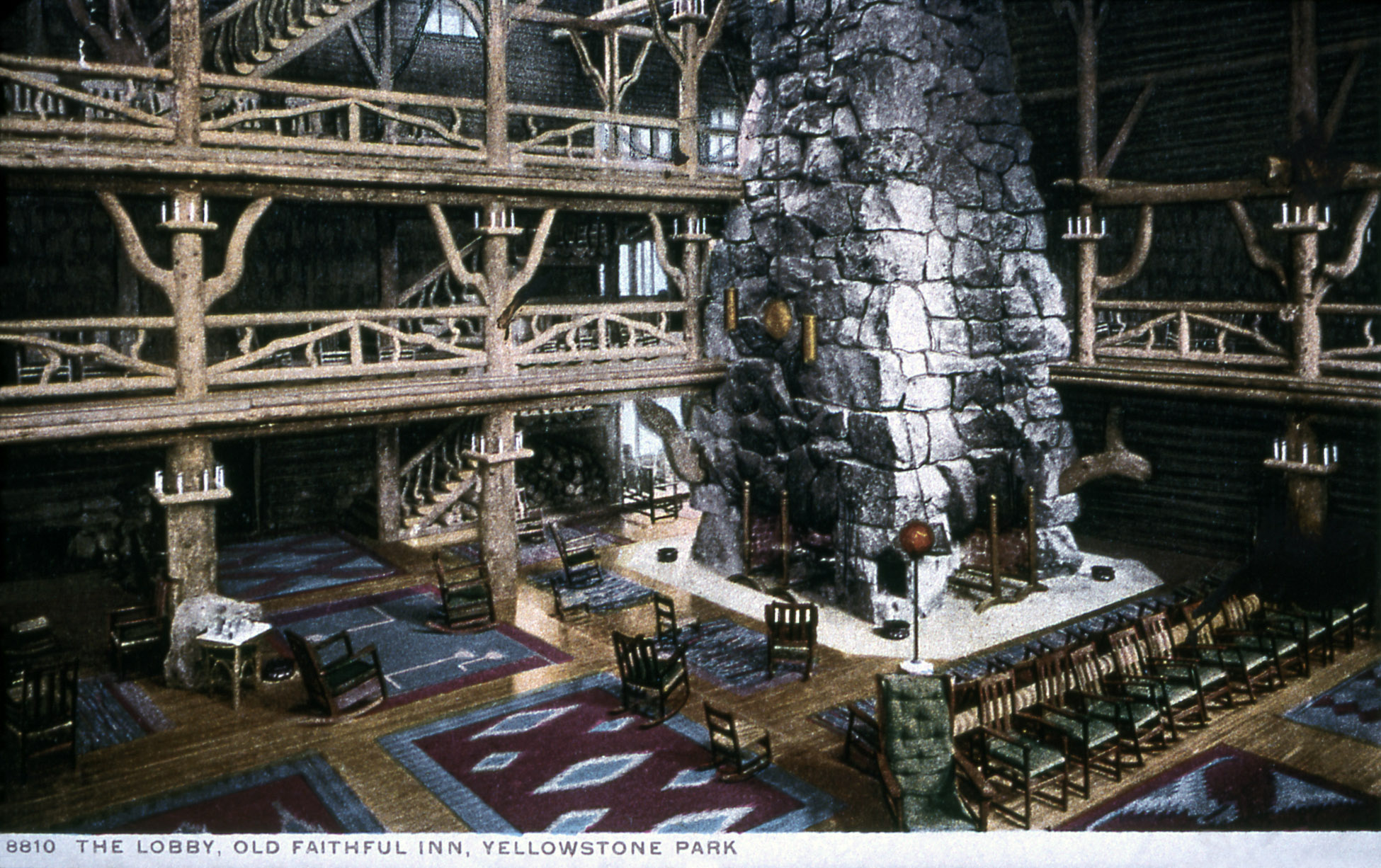
Old Faithful In Lobby; Frank J Haynes, image by nps.gov

In 2003 we paid only $75/night for a small but charming double bed room in the original hotel building, saving money by forgoing the en suite bathroom and using the shared bathroom instead (which was clean and perfectly fine). The same room in the 2014 season will run $109. There was a multi-million dollar renovation of the hotel from 2004-2012, which probably explains the slight cost increase. For around $100/night you get an incredible & unique experience in a beautiful lodge, something you have to pay several times more money for at the Ahwahnee Inn in Yosemite. Many people have complained online about the thin walls and basic accommodations in the Inn but to me that is part of the going back in time feel. I don’t need or want a phone, TV, or fancy amenities in a lodge that was built in 1904. I would rather have this:

Old Faithful Inn original room, image by http://www.yellowstone-notebook.com

There are also rooms in the c. 1920s west and east wings that are modernized. Before booking our room I read many online complaints about the rustic old rooms: how they are uncomfortable, noisy, drafty, lack bathrooms, etc. I was glad that I ignored the negatives and focused on the positives: charming, filled with character, like going back in time. Many thanks to the National Park Service and the companies involved in the recent restoration: A&E Architects, H-C Design & Consulting, and Xanterra Parks and Resorts (the concessionaire that runs the hotel), for not modifying the original character of the hotel and the “old house” guest rooms in the renovations.

You have to book way in advance for the privilege of staying at the Old Faithful. The summer of 2014 is fully booked, but there is still availability during the less crowded shoulder months of May, September, and the first half of October The lodge is closed from mid-Oct until mid-May.
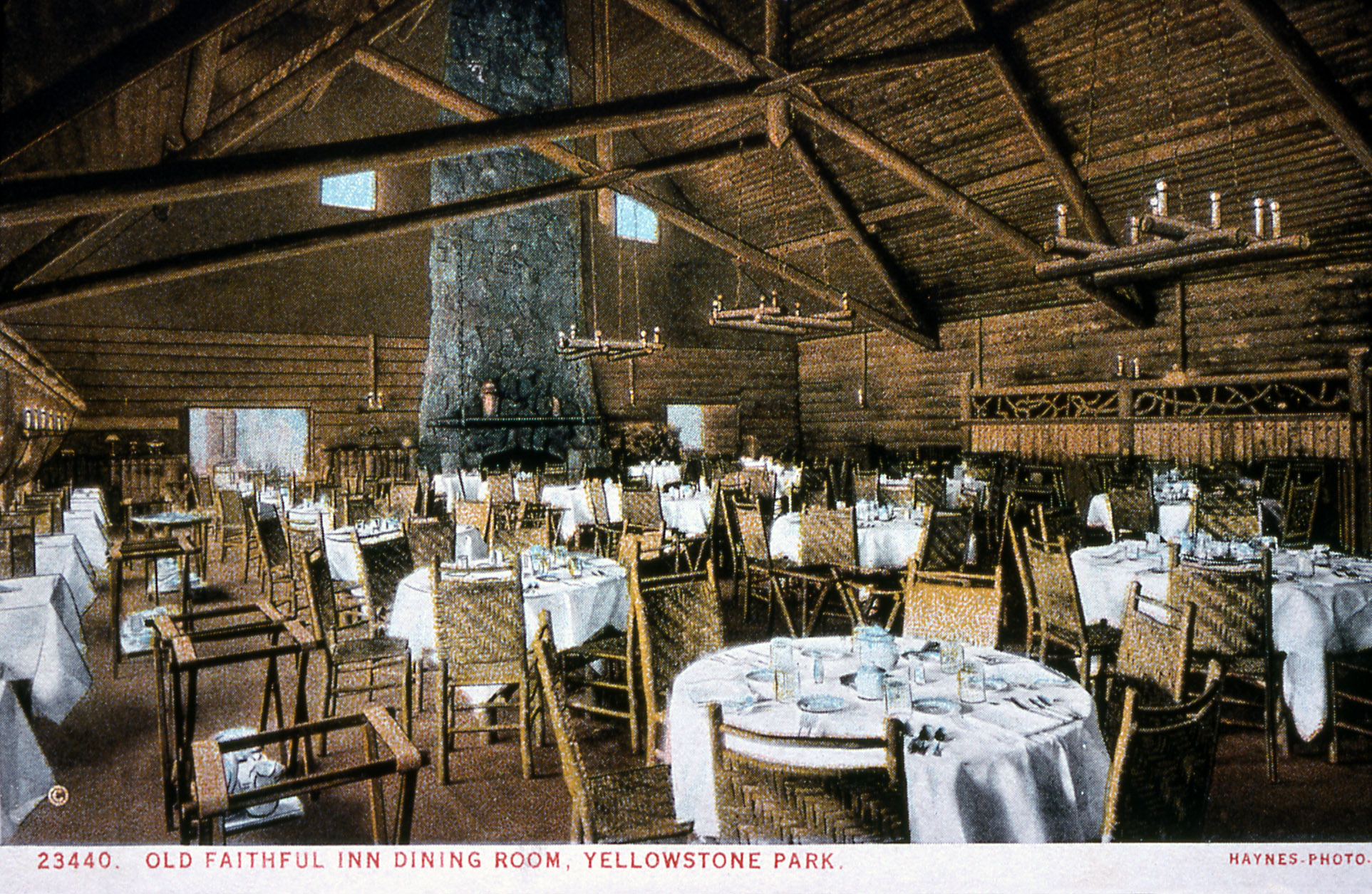
Old Faithful Inn Dining Room; Frank J Haynes, image by nps.gov

The dining room was constructed in the original phase in 1903-04 with exposed log scissors trusses and a huge stone fireplace.

At mealtime, guests in those early years ate together (appropriately dressed) in the rustic log-walled Old Faithful Inn dining room. A dinner bell atop the Inn alerted those venturing among the geysers and hot springs when it was time to return and make themselves presentable for dinner.

The dining hall was brightened with large windows, an open fireplace, and Reamer’s electric candle light fixtures. Guests sat on rustic chairs at tables set with brightly polished silverware and china of a blue willow pattern.

As guests ate, a group of musicians played for them on a small balcony extending from the lobby and overlooking the dining room. After dinner, these musicians climbed to areas such as the “crow’s nest” near the top of the high-pitched ceiling of the lobby. There they played as guests danced on the main floor far below. (Old Faithful Inn History)

The dining room is practically unchanged over 100 years later, even with the same hickory furniture built by the Old Hickory Furniture Company.
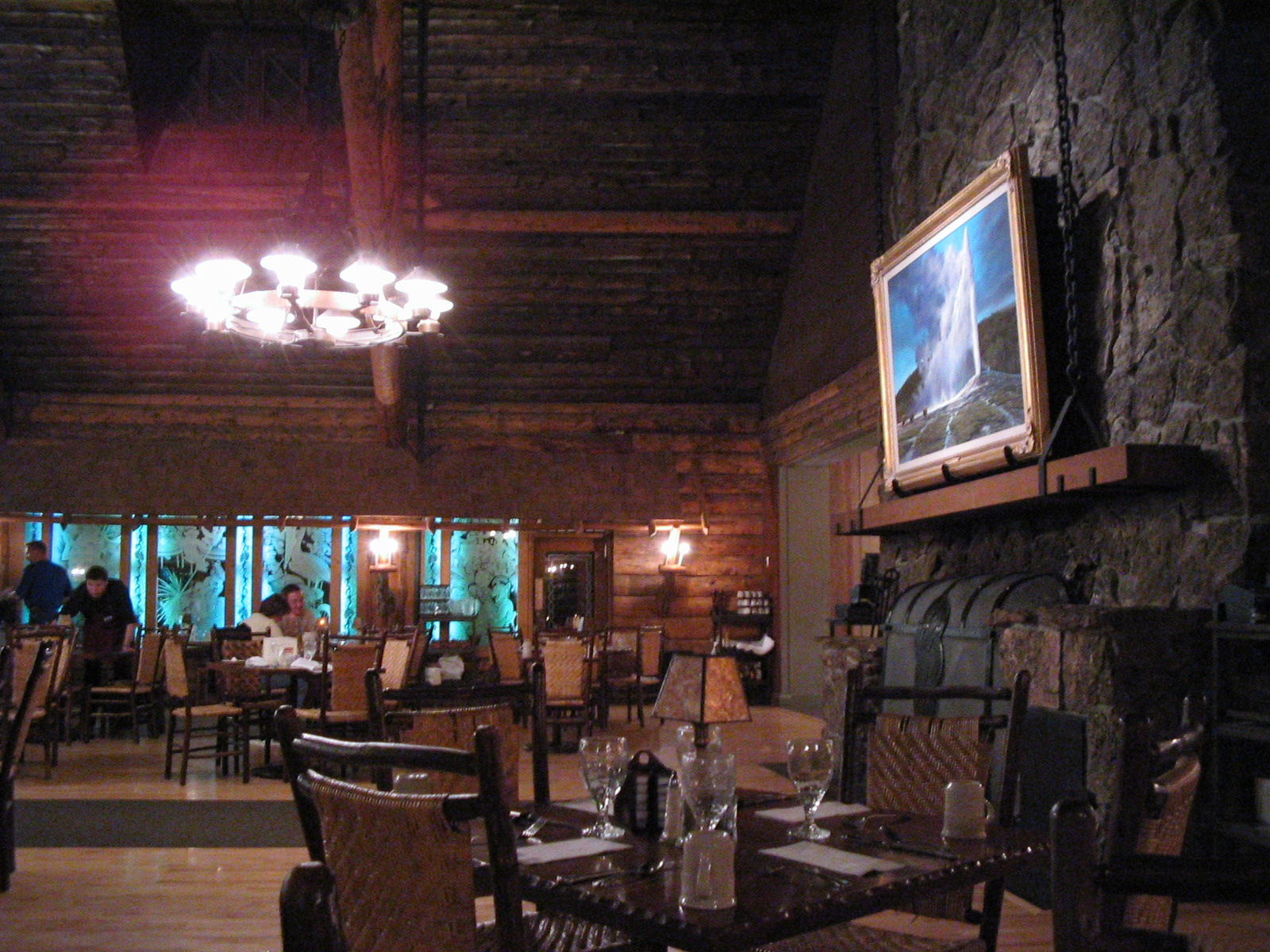
Old Faithful Inn Dining Room, photo by The Jab, 2003
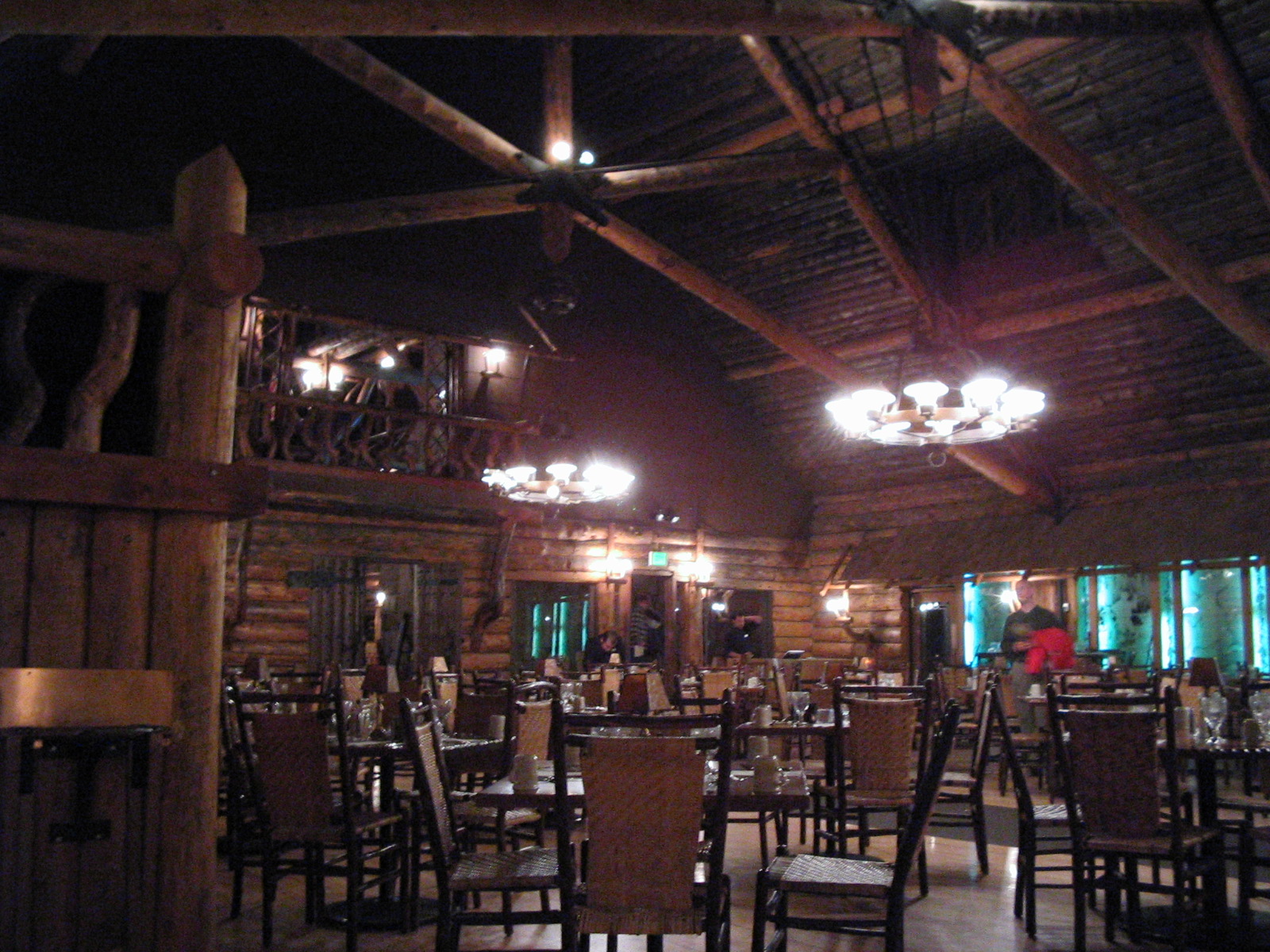
Old Faithful Inn Dining Room, photo by The Jab, 2003

Old Faithful Inn Dining Room, image by The Jab, 2003

Old Faithful Inn Dining Room, image by The Jab, 2003

In 1922 the dining room was expanded into a second dining room with more windows but a lower ceiling, and decorated with carved, painted wood panels of animals and birds native to the area (still present but no longer painted).

1922 dining room, image by http://www.yellowstone-notebook.com

In 1936, after the end of Prohibition, the Bear Pit cocktail lounge was built just off the lobby to quench the thirst of park visitors. The lounge featured wooden panels sandblasted with whimsical cartoons designed by staff cartoonists depicting bears engaging in human activities, such as one showing a bear spraying seltzer on some inebriated bears in a bar scene!

Bear Pit Lounge postcard, image by http://www.yellowstone-notebook.com

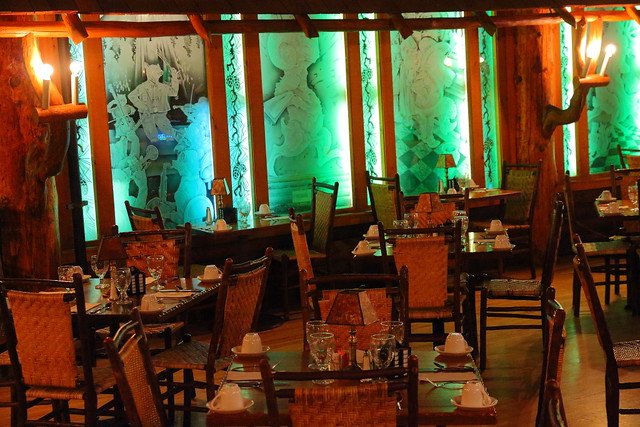
The Bear Pit lounge was converted into a coffee shop in 1962 and the cocktail lounge was relocated into an area next to the dining room. The comic wood panels were recreated in etched glass (visible in both the dining room and the cocktail lounge – see photos below). Some of the original wooden panels are now on display in the snack bar off the lobby. The furniture in the Bear Pit is all original from the 1930s.
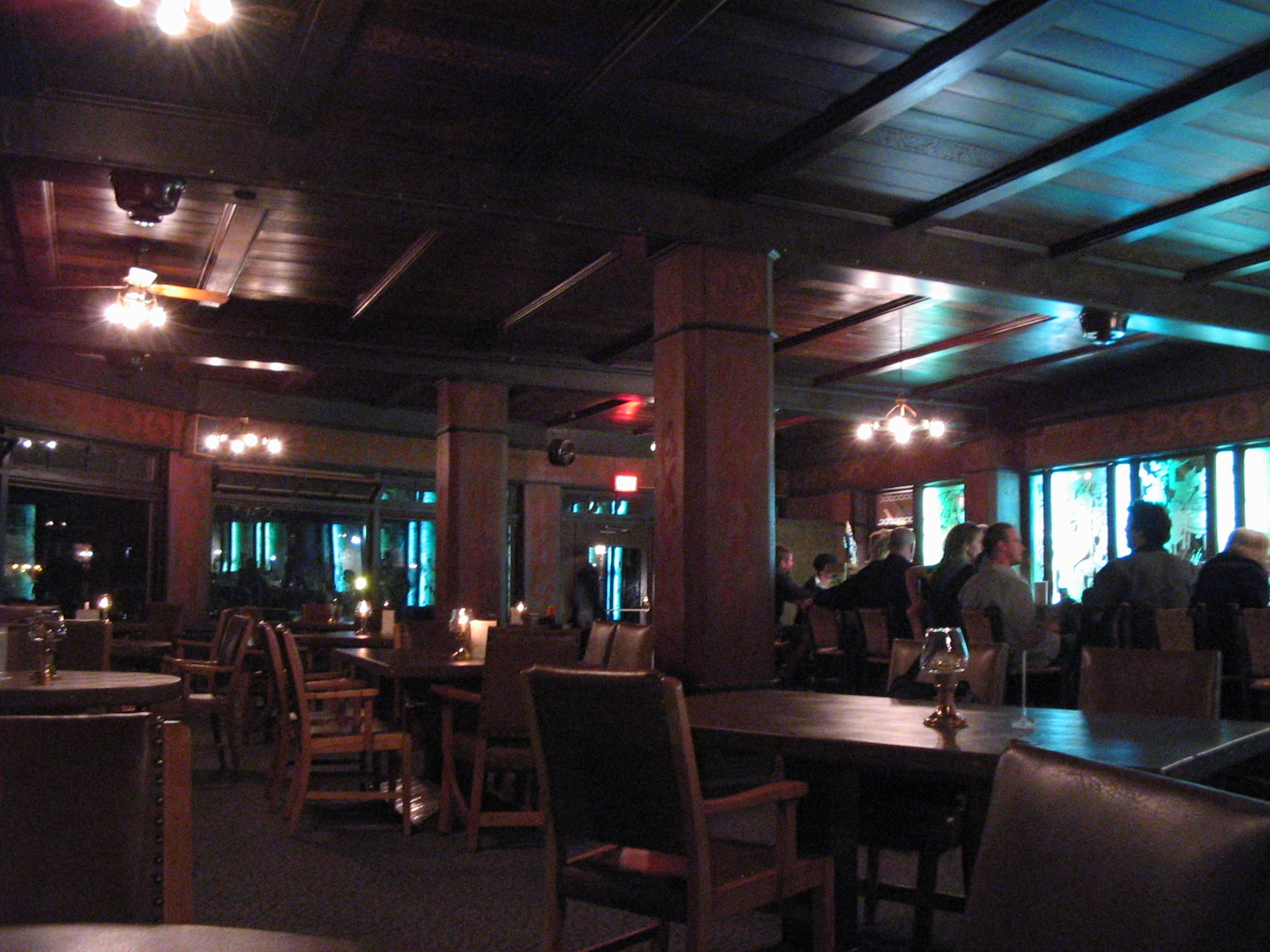
Bear Pit Lounge, photo by The Jab, 2003
Bear Pit Lounge, photo by The Jab, 2003
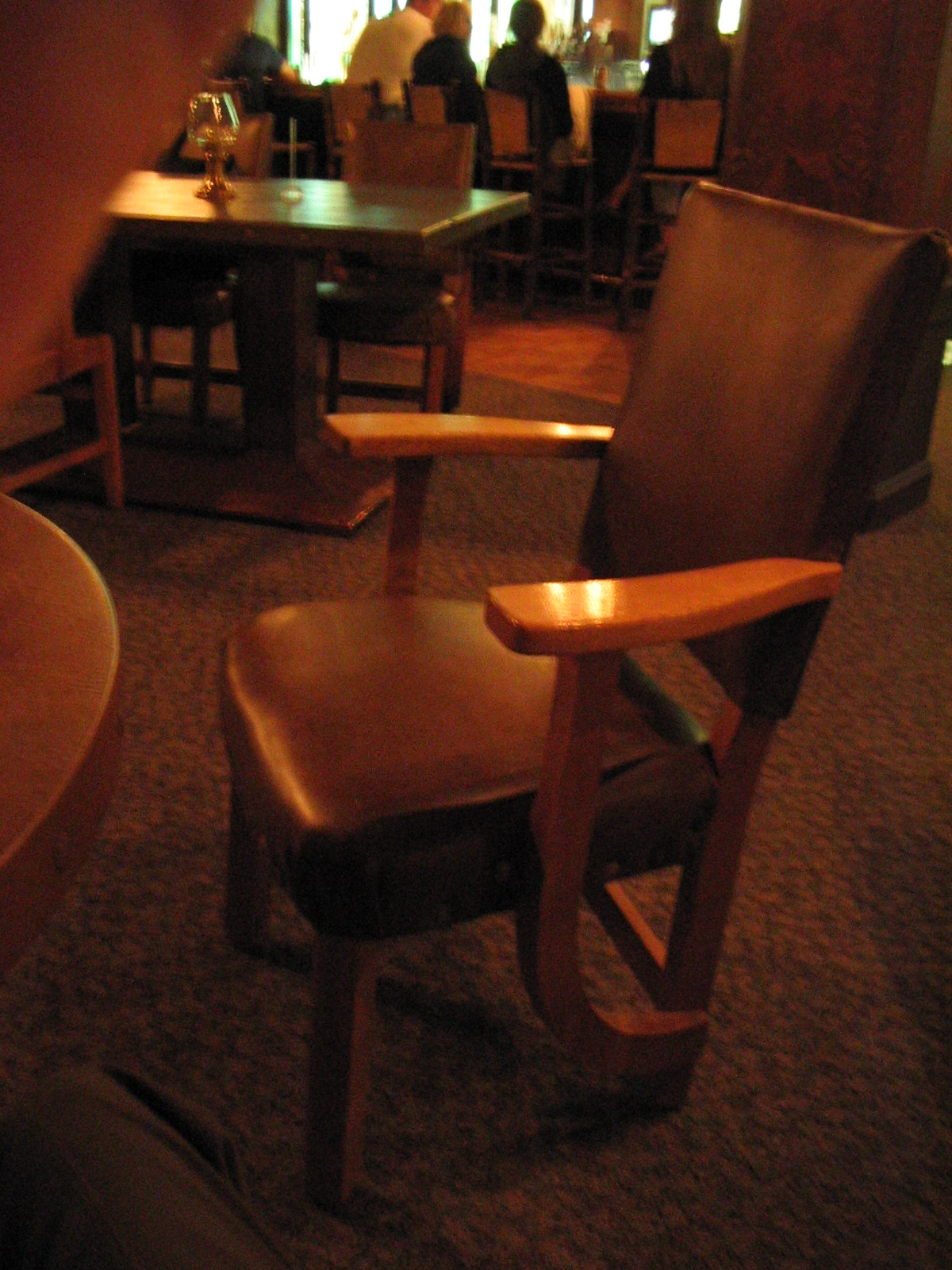
  Chair in the Bear Pit Lounge, photo by The Jab, 2003


Chair in the Bear Pit Lounge, photo by The Jab, 2003

IMG_5432 Old Faithful Inn Dining Room

etched glass panels in dining room, image by ThorsHammer94539 on Flickr

Now about the food. Based on my experiences in many National Parks (where food service is run by private concessionaires) the food costs more than comparable food would outside the park and ranges from downright bad to very good. But it just goes with the territory. Considering the setting and atmosphere you get what you pay for (average prices at the Old Faithful Inn Dining Room in 2012 were: Breakfast, $11; Lunch, $13; Dinner, $26). Lower your expectations, or camp and cook your own food. Also ask questions and order items that may be fresh or local. If they offer trout ask if it’s fresh from the area. Stick with classic American dishes. Don’t order Italian food (or Asian, Mexican, etc.). It won’t be as good as at your favorite neighborhood restaurant. Instead get a burger or a steak. In some parks you can drive outside the park to get better food. But even if the food isn’t that great in the lodges, just enjoy the atmosphere in the incredible rustic old dining room. I like to bring at least one dressy outfit on a visit to a historic lodge because it’s fun to get dressed up for dinner to enhance the time travel experience (just try not to look around at the other diners in their shorts and Teva sandals).
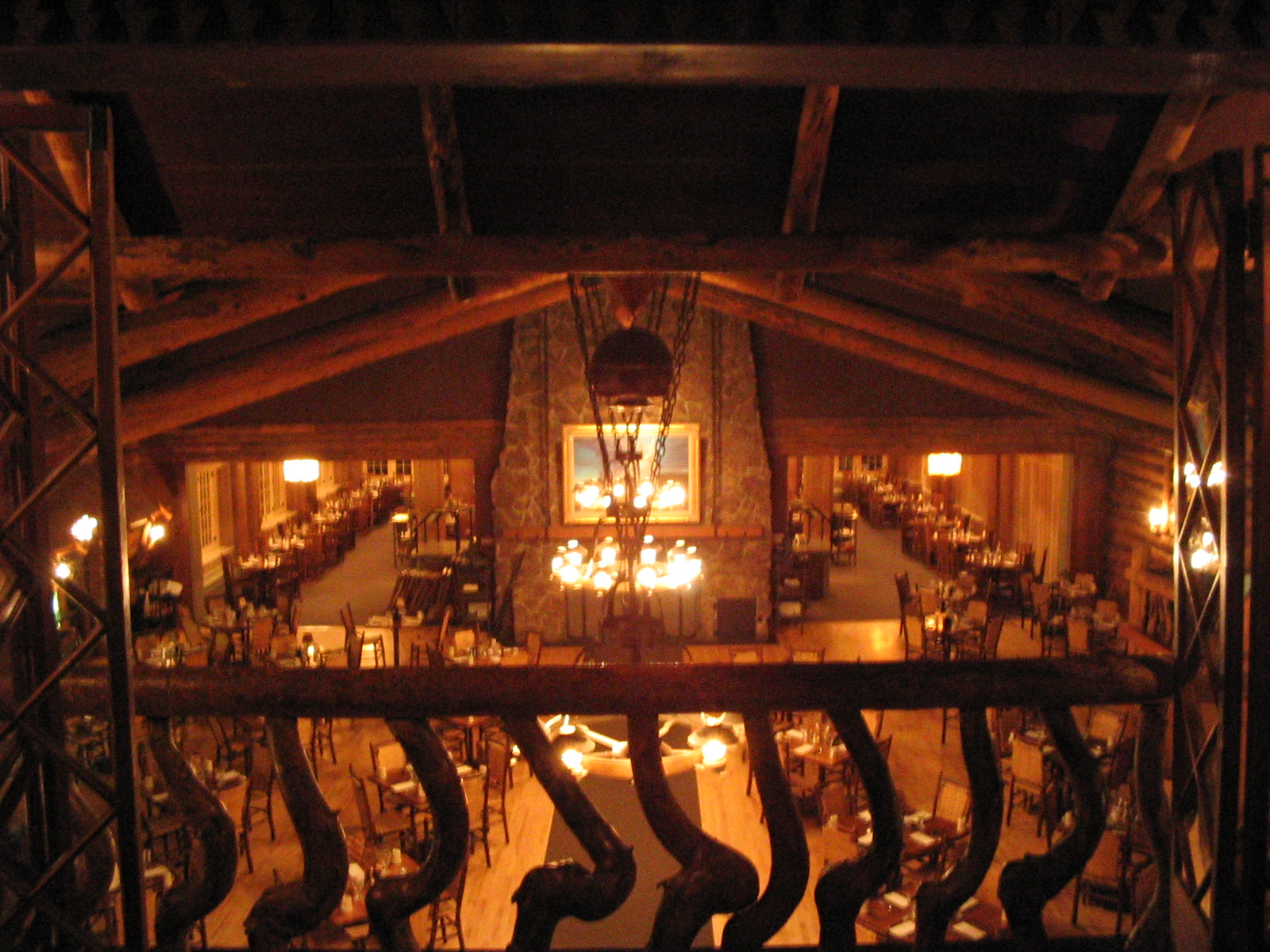
Old Faithful Inn Dining Room, photo by The Jab, 2003

Old Faithful Inn dining room from the second-story balcony, photo by The Jab, 2003

In 1987 the Old Faithful Inn was designated a National Historic Landmark. The statement reads:

“The first building in a National Park constructed in an architectural style harmonious with the grandeur of the surrounding landscape. Reflects Adirondack Rustic architectural idiom, but blown up to enormous proportions. Its seven-story high log lobby is unique in American architecture. Created with gnarled logs and rough sawn wood for the Northern Pacific Railroad, it has a sense of place as identifiable as the Park itself.”

Old Faithful Inn
Yellowstone National Park, WY
Dinner reservations: 307.344.7311
Open for breakfast, lunch, and dinner every day from mid-May through mid-October
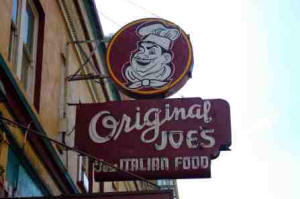
Original Joe’s, San Jose, California

Part two in Le Continental’s tour of the Bay Area’s restaurants named after Joe.

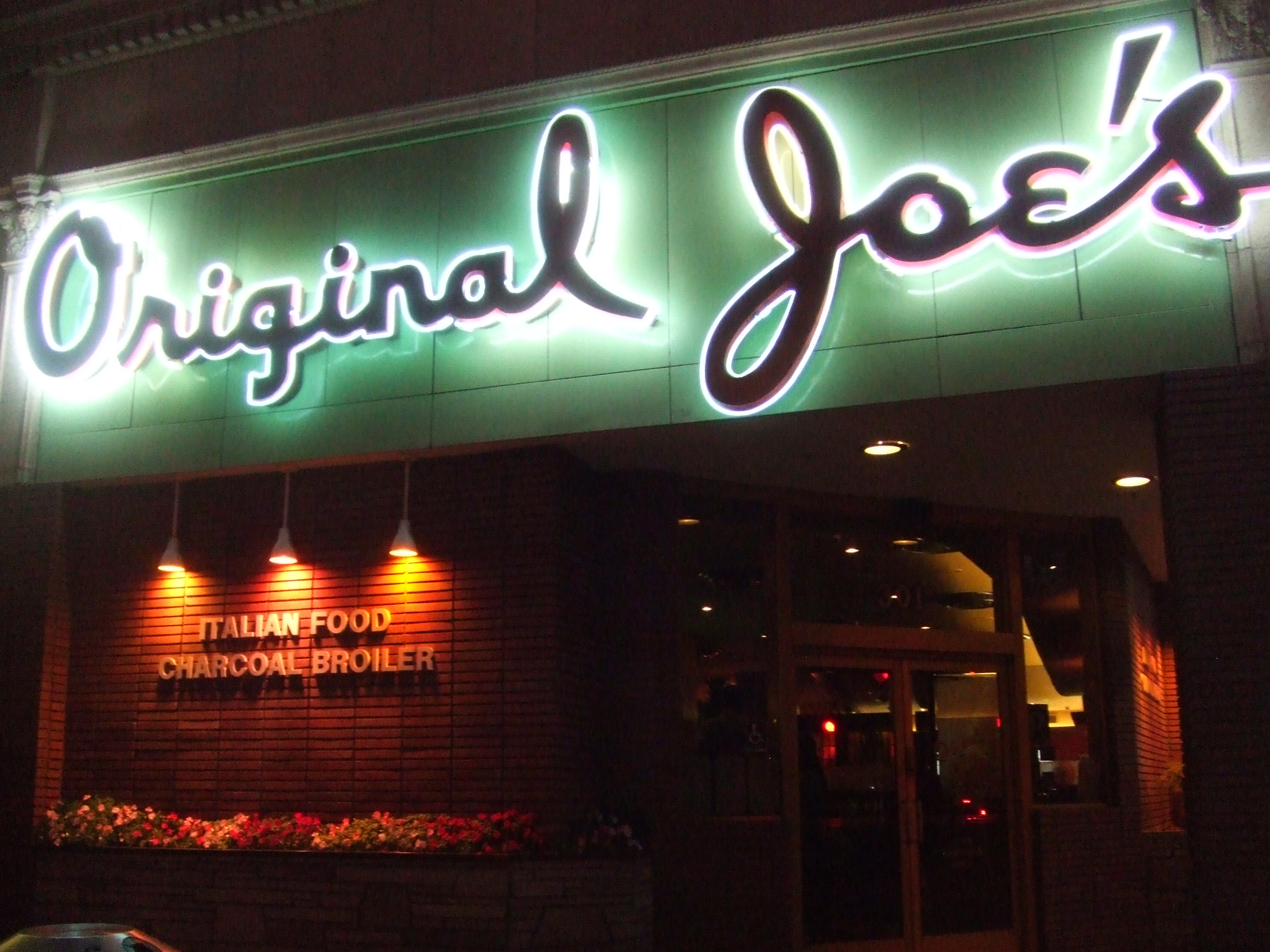
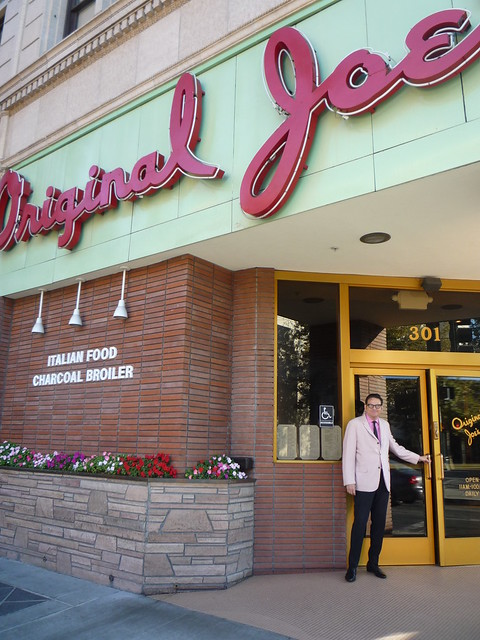
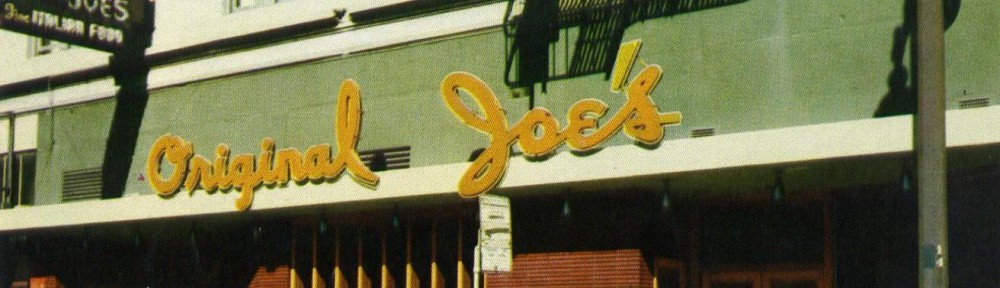
A couple of weeks ago we featured Original Joe’s relatively new location in San Francisco and learned a bit about the history of Joe’s restaurants.Today we’ll be visiting the second of the still-open Bay Area Joe’s to open, Original Joe’s in San Jose, which was opened in downtown in 1956 by Louis J. Rocca, one of the partners in the San Francisco Original Joe’s, along with his son, Louis J. Rocca Jr. (Babe), Arthur Tortore (Otto) and Anthony Caramagno (Nino). To this day the restaurant is still owned and operated by the Rocca family, namely Brad and Matt Rocca.

San Jose Joe's

photo by The Jab, 2009

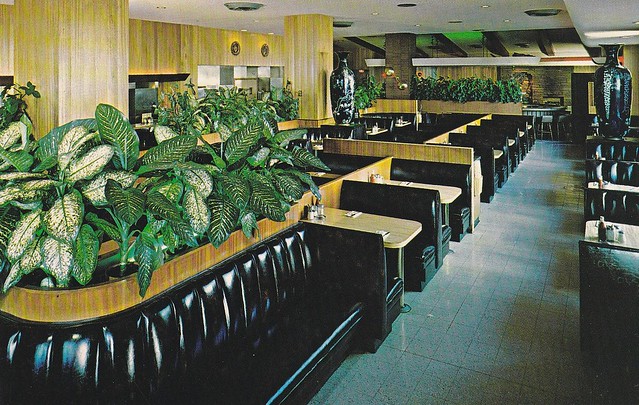
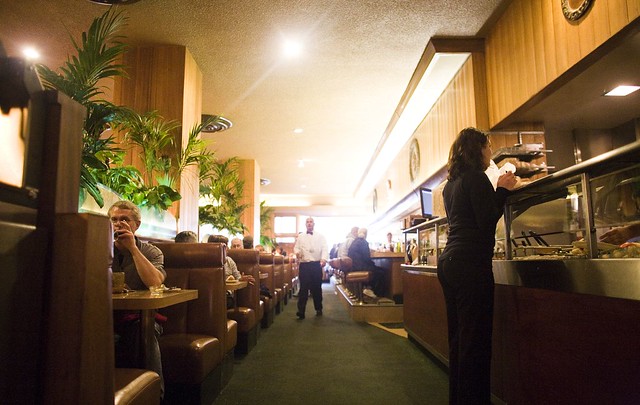
The first time I visited Original Joe’s San Jose in the late 1990s I was in awe of the frozen-in-time look of the place, not only on the outside, but on the inside too. Along with the San Francisco Original Joe’s in its original location, this was one of the best preserved mid-century restaurants in the entire Bay Area. Much of the decor was still the same as in the 1960s postcard below. Look closely at the background of the photo for a peek into the bar (view it at full size in the link) and you can get a bit of an idea of how spectacular that 1956 modern bar was (wall of Roman brick veneer with fireplace, vertical wood-paneled sections, freeform padded bar with low-back bar stools, backlit copper wall art, planter divider).

Original Joe's San Jose 1960s

Original Joe’s, San Jose, 1960s – postcard image by Heather David on Flickr

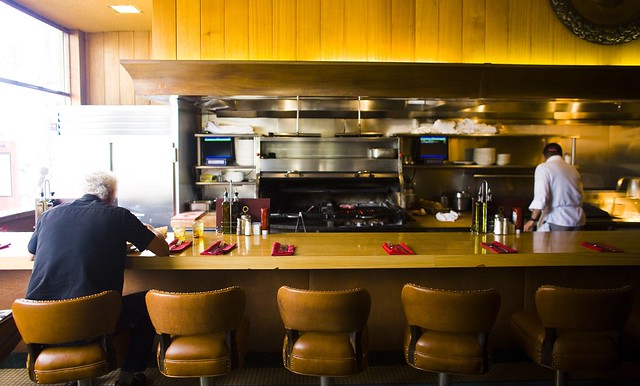
The restaurant was still almost the same inside in 2006, when the following pictures were taken (the only additions seem to be carpeting, glass partitions on the middle room divider, and different plants).

Original Joe's Interior

Original Joe’s SJ Interior, 2006, image by Thomas Hawk on Flickr

Joe's Counter

Original Joe’s SJ counter and exhibition kitchen, 2006, image by Thomas Hawk on Flickr

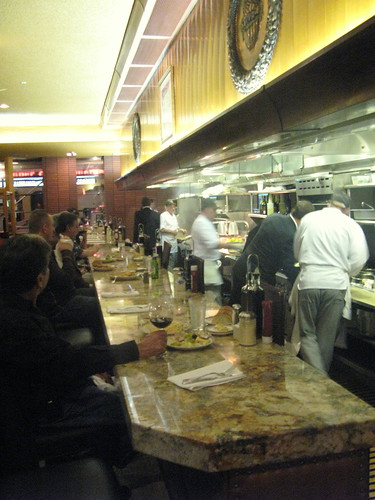
In the summer of 2007 the restaurant closed for a few months for an extensive retrofit and remodel. Thankfully, they didn’t ruin the old atmosphere in the restaurant. On the other hand, the bar didn’t fare so well. Sadly, it was remodeled beyond recognition. I do have a few quibbles with the restaurant remodel, namely the granite counters, which to me don’t look right in a classic restaurant. But I’m glad it’s still open and has some original features still present, such as the textured ceiling with indirect lighting, Roman brick wall veneer, wood paneling with copper decorations, planters, and even the original vases that you saw in the previous postcard from the 1960s!

Original Joe’s SJ dining room today, image by Eating and Loving San Francisco blog

Original Joe’s SJ dining room today, image by Eating and Loving San Francisco blog

Original Joe’s SJ counter, image by Jason Perlow, Off The Broiler blog

As you probably gathered from the photo above the waiters still wear tuxedo dinner jackets and bow ties and many are veterans at the restaurant, with the proper level of professional, non-nonsense service. Sometimes people complain online about this kind of old-fashioned service because it may seem unfriendly, but the way I look at it they are almost always very busy and want to give you quick service so they dispense with the chit-chat and get down to business. That’s fine with me.

A definite plus is their night owl friendly hours: they are open until 1:00am every night!

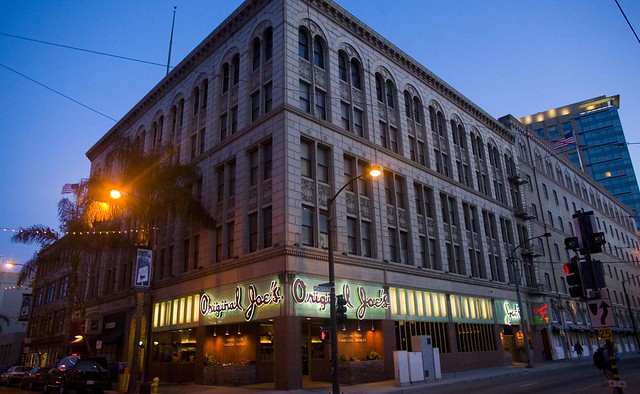
Dusk in San Jose

image by Thomas Hawk on Flickr

The menu is similar to the other Joe’s restaurants, featuring Mesquite grilled steaks, chops, and seafood, Italian dishes, and of course the Joe’s Special and charbroiled cheeseburger served on a French roll. The portions are enormous so the prices are reasonable. If you get spaghetti and meatballs for example, and I recommend it, you get a huge oblong plate covered with spaghetti, sauce, and a gigantic meatball that’s as big as a softball! I also recommend the steaks, which are aged Angus beef. Dinner entrees come with choice of French fries, baked potato, spaghetti, ravioli, or vegetables (also large portions).

Dinner at Joe's!

The Jab at Original Joe’s San Jose, 2009. Image by Carrie Swing on Flickr.

Original Joe’s, San Jose
301 S 1st St, San Jose, CA 95113
(408) 292-7030
Open daily, 11:00am-1:00am

Archie’s Waeside, Le Mars, Iowa

Ten years ago today I was on my second road trip across the western U.S. (the first was in 1999, from New Orleans to Oakland). My girlfriend and I attended the Exotica 2003 Tiki weekender in Chicago in August, then on August 26th we left Chicago on a 12-day, two-lane adventure across 8 states back home to Oakland, CA. I mention “two-lane” because we avoided the interstate freeways entirely. In my opinion the interstates serve one purpose: to get from point A to point B as fast as possible. But for touring the country they are lousy.

Le Continental’s Road Trip Tips

600px-US_50_svgBefore the interstate highway system was implemented during the height of the Cold War (in the 1950s) for civil defense reasons (the idea went back to FDR) there was a system of numbered U.S. highways. Federal highways started with the Lincoln Highway from New York to San Francisco in 1913. The U.S. highway numbering system was enabled in 1926. These U.S. highways are signed with a U.S. highway shield (see pic) and numbered evenly for west-east highways, starting with smaller numbers in the north (US10) and getting larger to the south (US90), and numbered oddly for north-south highways, starting low in the east (US1) and getting larger heading west (US101). You may be aware that interstate highways are numbered similarly (evenly for west-east highways and oddly for north-south) yet differently, with lower numbers in the south (I-10) going higher to the north (I-90) and lower numbers in the west (I-5) going to higher numbers in the east (I-95).

Despite many interstates replacing the U.S. highways (like I-40 along U.S. 66) much of the old U.S. highway system still exists as popular regional routes, mostly two-lane, but some four-lane (or wider) divided highways like the magnificent routes U.S. 395 and 101 in California. These highways are time travelers’ best friends! Especially when they exist at a good distance from interstates. On the interstates chain restaurants, motels, and stores pop up like weeds along cracks in pavement. The average travelers on the interstate are in a hurry and may be suffering from road fatigue, so they don’t want to have to search for reliable and safe lodging or think about where to eat because they aren’t familiar with the area. They desire chains, where the food is familiar (and usually processed, previously frozen, and bland), the motel room doors have key card locks, and the plastic cups are sealed in plastic. Where the chains thrive on the business of regular travelers and truckers older mom-and-pop owned motels usually cannot compete (unless they spend a lot of money on upgrades like key card locks and flat screen TVs). Sometimes older restaurants can compete if they are right on the interstate but in most cases interstates were planned and constructed at some distance from old highways and town centers, and it is usually difficult for the cafes along the old highway route to attract customers away from the interstate.

For these reasons I have a theory that the best preserved old highways in the U.S., that offer a feeling of going back in time, are the U.S. highways that have some history and that are a good distance from the interstates. Many great examples are in Jamie Jensen’s road trip bible Road Trip USA (my personal favorite road trip guide), such as U.S. 50, “The Loneliest Road In America”, still intact from Sacramento, CA into Utah and from Kansas City to Delaware, and U.S. 89, which traverses through several National Parks on its journey from Canada to Mexico. Along such routes you can experience vintage motels that are clean and safe, classic restaurants that thrive on local regular business as well as savvy road trippers, and occasionally see wonderful old roadside attractions. Along such routes I recommend you limit your daily travel to 200-300 miles, depending on attractions along the way, timing your overnights where there are interesting motels, restaurants, and bars.


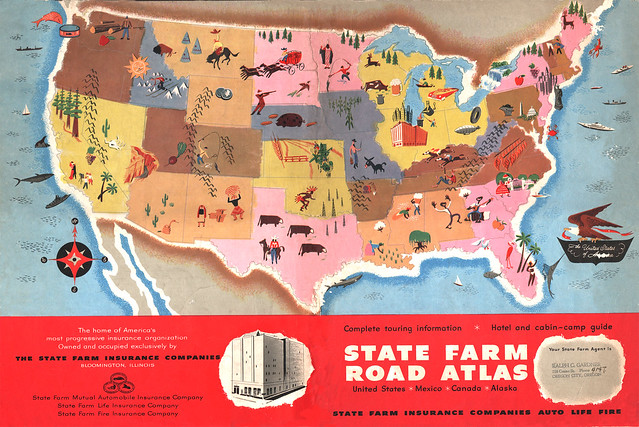
State Farm Road Atlas 1950


If you want to plan some interesting road trips on U.S. highways I also recommend getting a vintage road atlas like the above one (not my photo on Flickr, but I have a copy of the same atlas). It is easier to follow the original U.S. routes on the pre-interstate atlases and then compare them with more modern atlases to decipher their existing route (as some were swallowed up by the interstates while others were rerouted or renumbered).


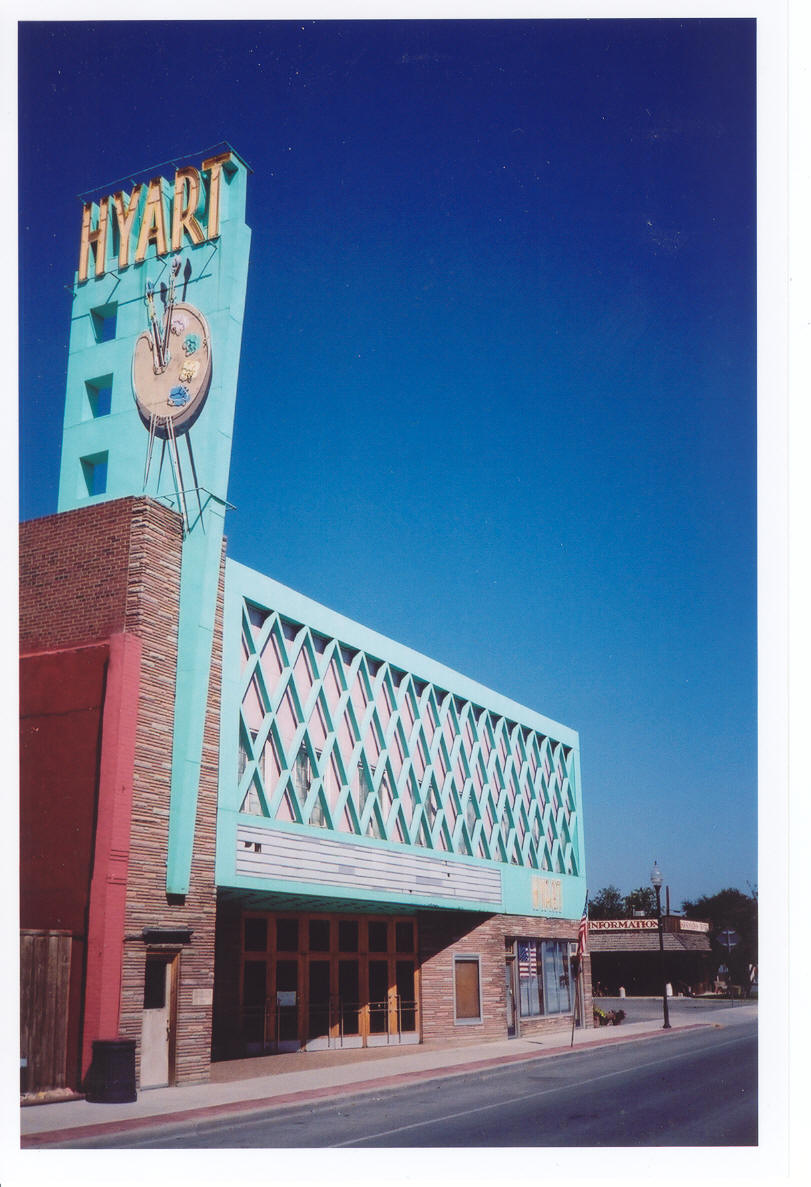
Hyart Theatre, U.S. 14, Lovell, WY - still in operation (since 1950)

Hyart Theatre, U.S. 14, Lovell, WY – still in operation (since 1950)


To return to my 2003 road trip story, our route went as follows:

  • U.S. 20 west from Chicago to Valentine, Nebraska, with an overnight stop in Dubuque, Iowa, a detour to Cedar Rapids, Iowa, to visit Brucemore (U.S. 20 has been a cross-country route since 1940 that starts in Boston and ends in Newport, Oregon), and another overnight in Sioux City, Iowa
  • U.S. 83 north from Valentine to Murdo, South Dakota
  • I-90 (U.S. 14) for a short while to visit Badlands National Park and the Black Hills of South Dakota (Mt. Rushmore), with two nights in Custer, SD
  • U.S. 16 west to U.S. 85 north to Wyoming 585 north to U.S. 14 west to overnight at Sheridan, Wyoming (with a stop at Devil’s Tower)
  • U.S. 14 west to Cody, WY, to overnight (with a picnic stop in the Bighorn Mts. and at Bighorn Canyon)
  • U.S. 20 west to Yellowstone National Park for a few nights at the Old Faithful Inn
  • U.S. 89 south from Yellowstone to Spanish Fork, Utah, with two nights near Grand Teton National Park
  • U.S. 6 west to U.S. 50 west (Delta, UT) to Oakland, California with an overnight in Ely, NV (usually I would take more time on U.S. 50 through Nevada but we were pressed for time and I eventually went back for a longer look).


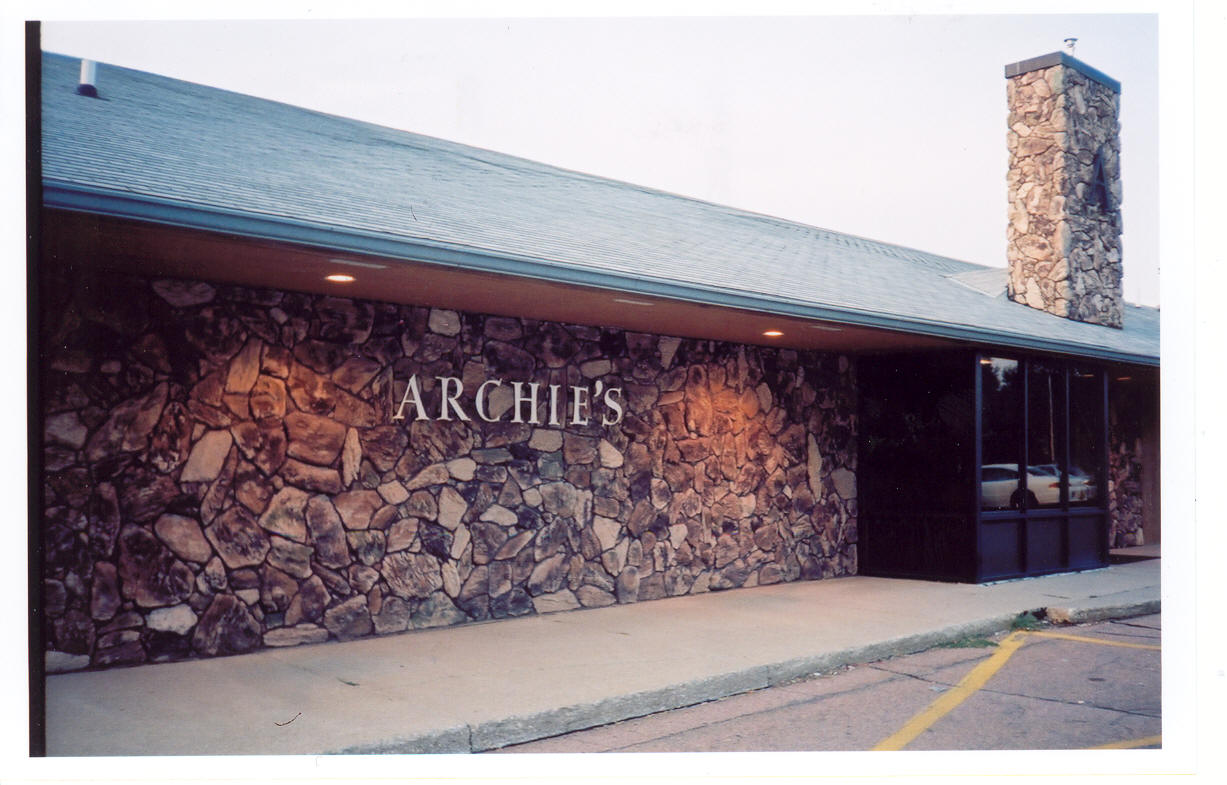
Archie's Waeside


In the small town of Le Mars, Iowa, just north of Sioux City, is Archie’s Waeside, a simple stone covered building with basic decor, but a steakhouse that serves some of the best steaks in the country. Opened in 1949 by Archie Jackson and still operated by the same family, the restaurant’s menu has several steaks (all prime dry-aged Iowa beef) to choose from and all dinners come with relish tray, bread, salad, and potato, served on vintage Syracuse china. Their wine list is renowned as the family often travel to California to buy wines.

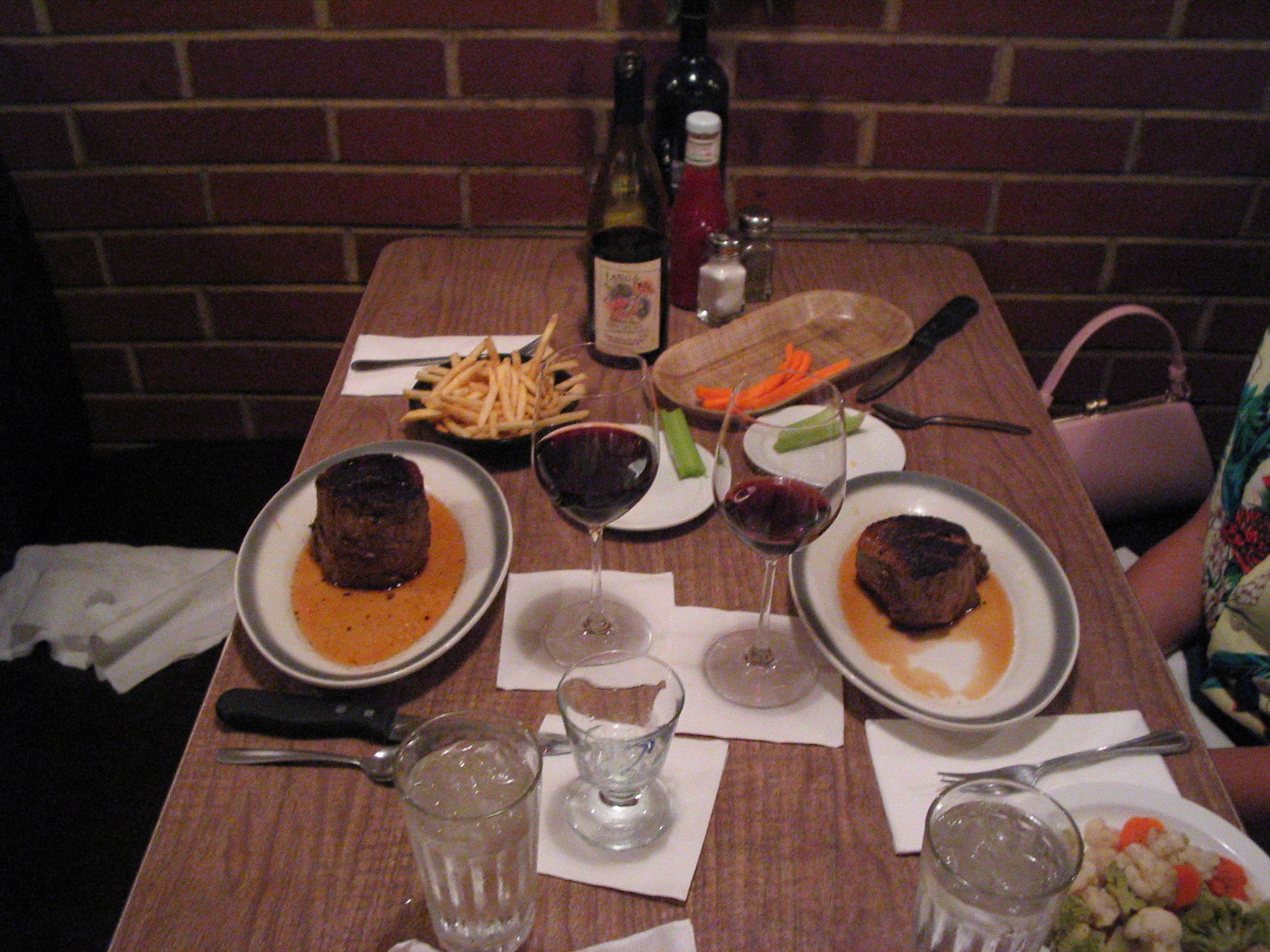
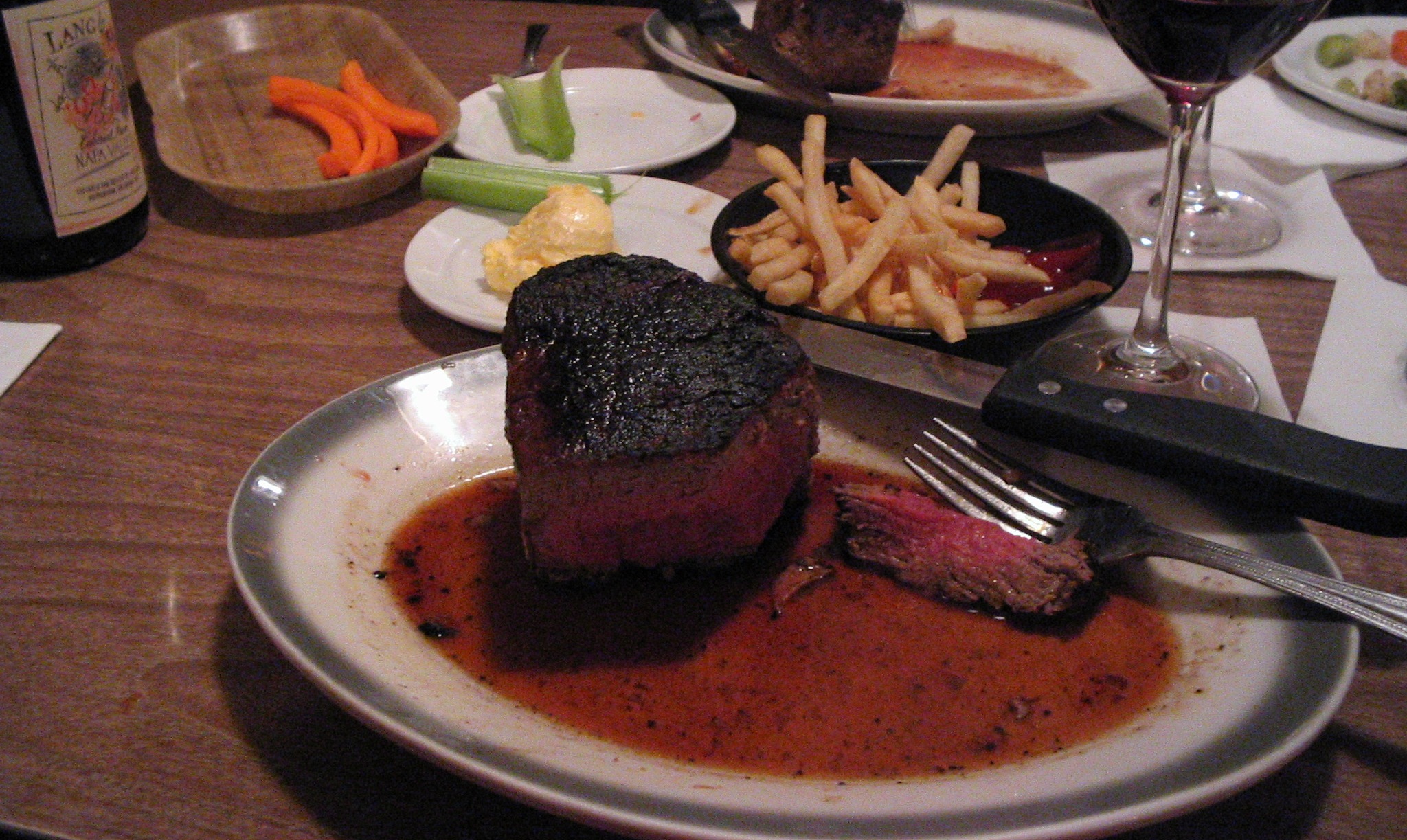
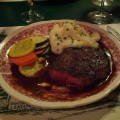
We ordered the house special thick Benny Weiker filet mignon (named after a regular customer in the past).


Archie's Waeside steaks

Words can’t fully describe the perfection of their steaks, so I’ll let my picture speak for me.


Archie's Waeside steak


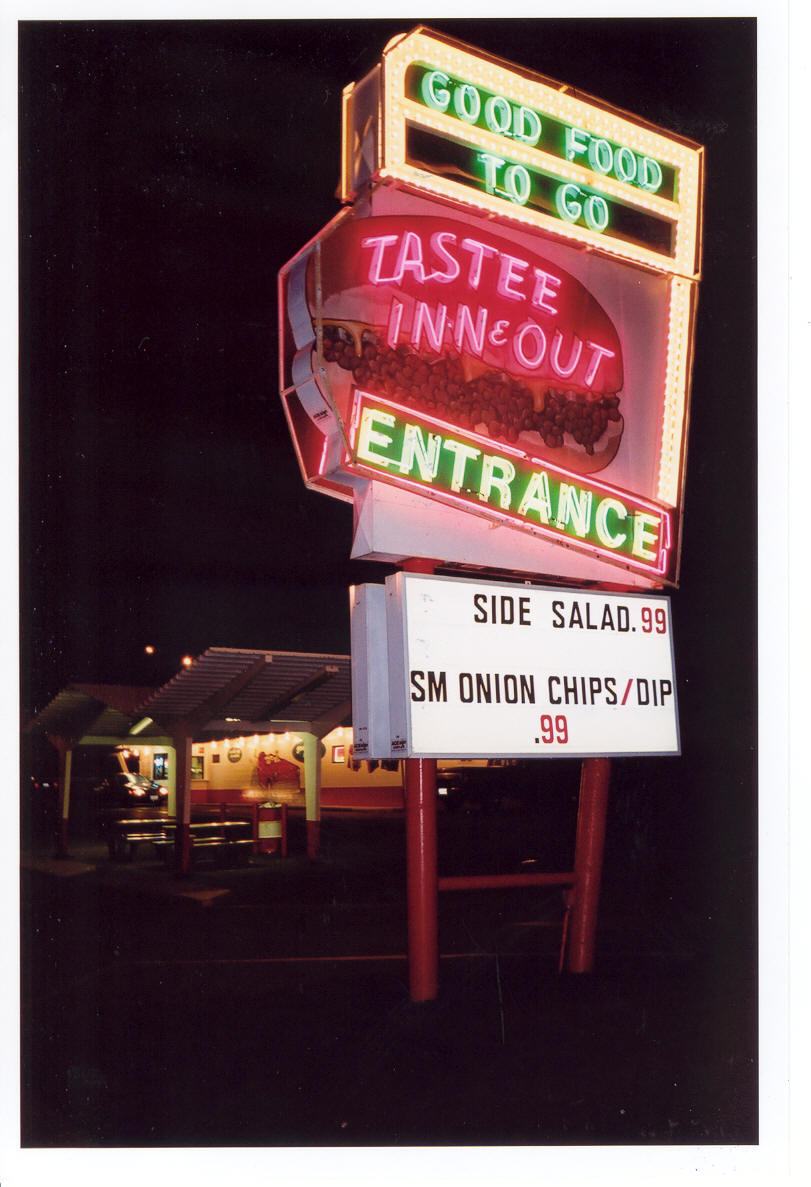
If you are in the area you must try a “tavern sandwich” (aka loose meat sandwich), a regional specialty. It’s a seasoned ground beef sandwich, like a sloppy Joe without sauce. Tastee Inn & Out is a great place to get one (make sure you try the onion chips too).


Tastee In 'n Out, Sioux City, Iowa

Tastee Inn & Out, Sioux City, Iowa


Happy trails!


Archie’s Waeside
224 4th Avenue NE, Le Mars, IA 51031
712-546-7011
Open Tue-Thu 5pm – 9pm, Fri 5pm – 10pm, Sat 4:30pm – 10pm, closed Sundays, Mondays, and holidays